|
Tuesday, March 08, 2011
By Selim Sahab Ettaba
Agence France Presse
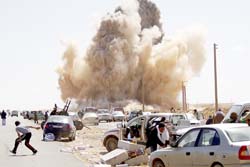
RAS LANUF, Libya: Explosions thudded in the desert and smoke coiled into the sky. Each time, a chaotic band of Libyan rebels manned anti-aircraft batteries to unleash a deafening barrage of retaliatory fire.
“Go to Ras Lanuf, but don’t go to Bin Jawad,” a man shouted into a loudhailer on the outskirts of this oil town, now the front line of the rebels’ battle to end Moammar Gadhafi’s four-decade grip on power.
Rebels nervously patrolled the road, stopping cars and instructing drivers, either reassuring them their destination was secure or warning “[it] isn’t safe” as Gadhafi’s warplanes flew overhead.
But handfuls of civilians could still be seen driving west toward the government forces.
Pumped-up rebels unleashed a torrent of fire at the circling jets, including rocket-propelled grenades that exploded in a puff of smoke.
But they were scattered and lightly armed near Ras Lanuf, and no longer visible on the approach to Bin Jawad, the hamlet they evacuated after falling into a deadly ambush and suffering heavy casualties Sunday.
In Ras Lanuf, the hospital where doctors had been overwhelmed just 24 hours earlier by the number of wounded, was deserted after medical staff evacuated their patients eastward and residents trailed in their wake.
“We heard that they are arresting and kidnapping people and we have to leave now,” said one father driving a silver sedan with two children in the back.
The only hotel evacuated its guests in the morning, citing fears of an attack, before reopening with a skeleton staff.
Among the rebels there was the customary confusion. Some said they were retrenching, others that they were resuming their advance.
“We’re going to Bin Jawad,” said Adel Mohammad al-Arred, a defected army captain with a machine gun slung over his shoulder and dressed in army fatigues, a keffiyeh tied around his neck. “We’re waiting here till we hear from people in Bin Jawad that all the families have left, then we will attack,” he said.
But there was a different version of events from Salahuddin Mohammad al-Sultani, a former policeman from Benghazi. Asked where the orders were coming from, he said: “We are all leaders. We are going to wait here. We are not going east. It’s a Gadhafi ploy for us to leave the oil fields,” he said.
An AFP reporter saw several cars packed with families going toward Bin Jawad. One man said he was taking his family to check on relatives. “Hopefully we’ll be there at 8 a.m.”
Abdulrahim Abu Bakr, a 54-year-old volunteer from the rebels’ stronghold of Benghazi, was responsible for checking cars coming into Ras Lanuf and warning others heading in the opposite direction to proceed at their own peril.
“I arrived last night from Benghazi. For the moment we are regrouping and waiting in a defensive position,” he said.
Another former army officer, he was one of the few dressed entirely in matching khaki fatigues, rather than a mishmash of camouflage, anorak and civilian clothes. He said there were still bodies left in Bin Jawad after the fighting.
“We’re waiting for orders from the national council to tell us whether to attack or just hold our line,” he said.
An AFP reporter saw him stop a car with three young people inside who had the flags of the former monarchy that the rebels have adopted stuffed in the boot as they drove into Ras Lanuf.
|