| |||
| Date: Aug 7, 2013 | |||
| Source: The Daily Star | |||
 | |||
| Tens of thousands march against government in Tunisia | |||
By Antoine Lambroschini:
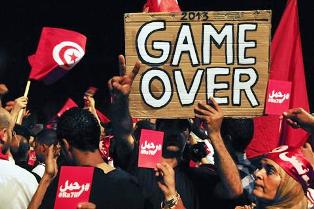
AFP TUNIS: Tens of thousands of people poured onto the streets of the Tunisian
capital to demand the resignation of the government as the political crisis in the north African
nation deepened. The country has been wracked by political unrest since
the July 25 murder of opposition lawmaker Mohamed Brahmi and Tuesday's protests marked the biggest
anti-government demonstration since the assassination. A police official
estimated that 40,000 people crowded the streets of Tunis to call for the government led by the
moderate Islamic movement Ennahda to step down. Opposition leaders cited in local media put the
figure at 100,000-200,000. Earlier on Tuesday, the National Constituent
Assembly (ANC) -- a body elected in 2011 to forge consensus on drafting a new constitution -- was
suspended. Brahmi's murder, as well as that of another opposition
politician, Chokri Belaid, have been blamed on radical Islamists, with the Ennahda-led cabinet
criticised for not doing enough to prevent them. The demonstration
attracted a mixed bag of opposition parties, ranging from extreme left to centre-right, and was
timed to mark six months since Belaid was gunned down outside his
home. Protesters carried pictures of both Belaid and Brahmi and shouted
slogans such as "The people want the regime to fall" and "The government will end
today". The march passed off
peacefully. Assembly speaker Mustapha Ben Jaafar said the ANC's work
would be halted until the government and opposition opened negotiations to break the deadlock "in
the service of Tunisia". Brahmi's killing had already prompted several
opposition members to boycott the ANC and its suspension was a key demand of the protesters on the
street. The stalemate showed no sign of ending, however, with the
opposition refusing to hold talks with the government until it steps down and Ennahda ruling out any
dialogue conditional on its ouster. Larayedh has refused to quit,
offering instead to broaden the coalition. Ben Jaafar criticised the
country's politicians for failing to find a compromise as Tunisia also battles mounting terror
threats. "Despite the gravity of the situation and instead of working
towards unity, unfortunately party leaders have gone in the opposite direction, towards division, by
mobilising" street protests, he said. Since the ANC was elected in
October 2011, political leaders have failed to find a consensus on a new constitution following a
revolution that ousted longtime president Zine el Abidine Ben Ali. And
the suspension of the assembly's work throws into question Prime Minister Ali Larayedh's target of
the ANC adopting a new constitution and electoral law by October 23 ahead of a December 17
election. Ennahda chief Rached Ghannouchi, quoted in La Presse newspaper
on Tuesday, said the government will not step down under pressure from the street, while Larayedh
charged that demonstrators were hampering efforts by security forces to root out gunmen linked to
Al-Qaeda. "There are excessive demands at protests for the dissolution of
the elected government," Ghannouchi told La Presse. "In democratic
regimes, protests don't change governments. It's under dictatorial regimes that a demonstration is
able to topple a regime." Earlier Tuesday, before its work was suspended,
the ANC had gathered to discuss the "terrorist crisis" as security forces pressed on with a vast
operation to hunt down militants holed up in the rugged Mount Chaambi region near the Algerian
border. Speaking to the assembly, Larayedh had harsh words for the
demonstrators, saying their activities meant security forces "are obliged to be in the streets when
they should be participating in the battle against terrorism". Defence
Minister Rachid Sabbagh told the ANC that the armies of Tunisia and Algeria would "reinforce their
cooperation, particularly to arrest the Chaambi terrorists.". "We will
continue our operations until all the terrorists have been killed or arrested," said the
minister. Ghannouchi also dismissed the criticism that authorities are
being soft on radical Islamists, who have grown in influence since the popular uprising that toppled
Ben Ali two years ago. "There are 500 to 600 terrorist suspects
imprisoned in jails," he noted. | |||
| |||