|
Tuesday, March 08, 2011
Tunisia announced a new interim government free of any members of the regime of toppled Zine al-Abidine Ben Ali Monday, and also scrapped a security agency that had targeted political dissidents.
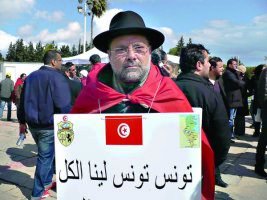
Seeking to assert their authority and gain legitimacy in the eyes of protesters who forced Ben Ali to flee on Jan. 14, the caretaker authorities are attacking the remaining vestiges of his 23-year rule, one by one.
Prime Minister Beji Caid Essebsi unveiled a new Cabinet of technocrats rather than career politicians, none of whom had served in previous governments under Ben Ali.
He told a news conference the ministers had been chosen in the public interest to see through a delicate transition until Tunisians elect a national constituent assembly on July 24.
“This is a temporary government which will be in office for only 4 1/2 months, to save the country from the grave situation it finds itself in,” he said.
The new Cabinet includes five ministers, to replace ones who quit last
week, and two women. The new lineup returns 17 officials to posts they occupied in a government formed on Jan. 27, with none of its members signed up to any political party.
Shortly after the Cabinet lineup was announced, an Interior Ministry spokesman said Ben Ali’s political police and state security apparatus had been dissolved – a core demand behind the popular uprising. “I can confirm that it was decided to terminate them. We will take other decisions that will please the people,” he said.
A ministry statement announced a series of measures including “the definitive break with any form of organization resembling the political police at the level of structure, mission or practice.” The statement said that “these practical measures are in harmony with the values of the revolution.”
The twin security organs had functioned as a domestic spy agency with wide powers to suppress opposition to the regime.
“It is a dream come true for everyone,” said Ali Larayedh, a member of the moderate Islamist Ennahda movement, which has just been allowed back on the political stage after a two-decade ban. “People have suffered because of them. They wrecked politics, the media and the judiciary in this country,” Larayedh, who said he himself had spent 14 years as a political prisoner, told Reuters.
Caid Essebsi, 84, was appointed on Feb. 27 after two previous caretaker administrations collapsed under pressure from protesters demanding that Ben Ali’s old guard, including his long-time prime minister Mohammad Ghannouchi, be purged from government.
The new prime minister said Monday his priority was security. “Without it we can’t have economic development or a political agenda. We want foreigners to visit. People do not invest their money if they are not convinced the situation is calm.”
No minister in the new government will be allowed to stand in future elections.
Asked if protesters would be satisfied with the latest concessions, Caid Essebsi noted that the Tunis square where demonstrators had staged sit-ins until Friday was now empty. “They are not there anymore, they left spontaneously and that proves that they trust me. I will not betray their trust.” – Agencies
|