|
Friday, March 11, 2011
Libyan leader Moammar Gadhafi is ready to unleash the full might of his forces to crush a three-week-old insurrection, his son said Thursday as warplanes and tanks struck at the country’s rebel-controlled east.
Seif al-Islam’s warning came as the opposition was making gains on the diplomatic front.
France and Britain called on the EU to consider the country’s transitional national council a valid political interlocutor; the Obama administration cut ties with Libya’s remaining representatives in the U.S. and the Gulf Cooperation Council declared Gadhafi’s regime as illegitimate.
“It’s time for liberation. It’s time for action. We are moving now,” Seif al-Islam told Reuters in an interview. “Time is out now … we gave them two weeks [for negotiations].”
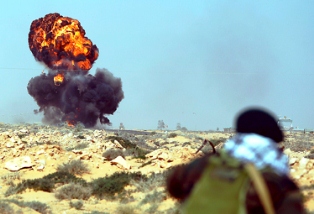
As he spoke, Gadhafi’s forces intensified their counter-attack on the insurgent heartland, bombarding rebel positions in the oil port of Ras Lanouf. Warplanes also hit Brega, another rebel-held oil hub further east.
State television said the army had driven the rebels out of Ras Lanouf, just behind their frontline, but the rebels denied it.
Gadhafi forces and rebels were locked in street fighting in the western town of Zawiya, close to Tripoli, which has changed hands several times in recent days. Residents described scenes of carnage, with women and children among the dead.
With momentum appearing to turn against the rebels, foreign governments held more meetings where they again called for Gadhafi to surrender.
In a joint declaration addressed to the president of the EU Council Herman von Rompuy, French President Nicolas Sarkozy and British Prime Minister David Cameron said Gadhafi and his ruling clique have lost legitimacy and must step down to end violence in the country.
They called for plans to prepare to help the Libyan rebellion and said these could include imposing a no-fly zone over Libya.
The leaders also called on the EU to recognize the Libyan National Council, which represents the rebellion against Gadhafi, as a viable political entity.
“We support the efforts of the Libyan Interim Transitional National Council to prepare for a representative and accountable government,” they said.
Earlier, the U.S. and NATO’s head expressed doubt over the wisdom of imposing no-fly zones without full international backing, strong Arab support and a legal justification.
“We considered … initial options regarding a possible no-fly zone in case NATO were to receive a clear U.N. mandate,” NATO Secretary-General Anders Fogh Rasmussen said after a meeting of NATO defense ministers in Brussels. “Ministers agreed that further planning will be required.”
NATO however said it would move ships closer to Libya in response to the continued violence. The ships would bolster surveillance of Libya and monitor an existing arms embargo against the country.
U.S. Secretary of State Hillary Clinton also expressed deep doubts about proposals to set up a no-fly zone over Libya, saying previous such zones set up over Iraq and Serbia had had little effect.
Earlier Tuesday, Sarkozy raised the idea of targeted bombing of Libya during talks with members of his UMP political party, three party sources said.
“Extremely limited, but targeted strikes in specific cases and not necessarily on airbases is being explored,” a member of Sarkozy’s party told Reuters.
Mahmoud Jebril and Ali Essewi of the Libyan National Council met Sarkozy in Paris Thursday, after which Paris announced that it would recognize the council as the legitimate representative of the Libyan people.
An aide to President Nicolas Sarkozy said an ambassador would go to Benghazi and a Libyan envoy would be received in Paris.
In an Arab boost to the freedom fighters, GCC foreign ministers meeting in Riyadh stressed Thursday that the Libyan regime of Gadhafi is illegitimate and that contacts should be initiated with the rebels.
Speaking at a House budget hearing, Clinton announced that Washington was suspending relations with Libya’s embassy to the U.S. She said she would meet with Libyan opposition figures when she travels to Egypt and Tunisia next week, marking the highest level contact between the U.S. and anti-Gadhafi fighters.
Libyan Deputy Foreign Minister Khaled Kaim said Libya may sever diplomatic relations with France and other powers if they back the anti-Gadhafi fighters.
Despite increasing pressure from the international community, the Libyan government was making a last-minute effort to sway them. Mohammad Tahir Siala, a Libyan envoy, met Thursday with two Greek Foreign Ministry officials. He had held similar talks in Lisbon Wednesday with Portugal’s Foreign Minister Luis Amado. The Portuguese daily Publico Thursday quoted a diplomatic source as saying Gadhafi would agree to talks on the transition of power, after Amado met Gadhafi’s envoy in Lisbon. The source told Publico the message had to be taken with caution as it was given in response to Amado’s proposals for a cessation of hostilities and a peaceful change of power.
Seif al-Islam said in his interview that Libya would defeat the rebels even if Western powers intervened. “We will never ever give up. We will never ever surrender. This is our country. We fight here in Libya,” he said, speaking in a compound in Tripoli. “Libya is not a piece of cake.”
He described rebels fighting to end Gadhafi’s rule as terrorists and armed gangsters and said thousands of Libyans had volunteered to fight them.
More than 500 kilometers east of Gadhafi’s stronghold, warplanes and gunboats bombarded rebels in Ras Lanouf. Missiles crashed near a Libyan Emirates Oil Refinery Company building. Rebel fighters said Ras Lanouf’s residential district, including the hospital area, weathered a bombardment and one said government forces were advancing into the area, backed by rocket fire from sea, air and ground.
Rebels also reported an air strike on Brega, another oil port 90 kilometers east of Ras Lanouf, indicating that Gadhafi loyalists had not only halted a westwards insurgent push in its tracks but were making inroads into their eastern rearguard.
They fired anti-aircraft guns toward warplanes and rockets out to sea toward navy ships, without visible effect.
State television said rebels were ousted Thursday from the port and airport of Es Sider, another oil terminus about 40 kilometers up the coast west of Ras Lanouf. The poorly-equipped rebels conceded they were struggling to hold ground against the government’s vastly superior firepower.
In the west, Gadhafi’s troops laid siege to try to starve out insurgents clinging to parts of the shattered city of Zawiya after see-saw battles. One fighter said rebels had retaken the heart of Zawiya from the army overnight. – Agencies
|