|
By Marie Dhumières and Van Meguerditchian
Monday, March 14, 2011
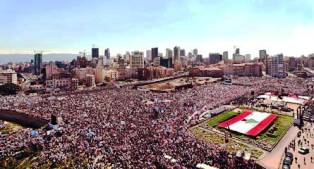
BEIRUT: For the hundreds of thousands of March 14 supporters who flocked to Downtown Beirut’s Martyrs Square Sunday, this year’s celebration carried a special significance, as its core message was directed to internal rather than foreign parties.
“In the past years, we focused on protesting against Syria’s meddling in Lebanese affairs, but this is the first time we’re gathering for a new purpose: to take [Hezbollah’s] arms down,” said Michel Naccache, a 31 year-old entrepreneur.
“We’re breaking the taboo of Hezbollah’s weapons, which has been a taboo for a long time,” he added.
For many protesters, Sunday was not particularly about politicians’ speeches or political programs but more an occasion for a show of strength against their political opponents.
“This is mainly about letting them know about the people who are against weapons,” Panos Aprahamian, a 24-year-old advertising producer for a TV channel said. Supporters dismissed the idea that they were following the example of recent uprisings that have shaken the Arab world.
“We don’t want change from the streets, we want a change from within institutions,” Frederic Dib, a 22-year-old businessman said.
Naccache agreed. “We’re starting a process by proclaiming what we want. This is not a revolution,” he said.
Protestors also dismissed rumors that they have been paid to make it to the demonstration.
Omar Merheb, 41, who made the trip from Saudi Arabia said: “These are all false accusations, we bought our tickets to fly to Beirut yesterday to join this national day,” Merheb added.
But Aprahamian was not surprised. “I’m sure some people got paid to come here, it happens every time there is a demonstration, no matter the party organizing it.”
Protestors argued that Hezbollah’s weapons were jeopardizing the democratic process. Several expressed the view that voters, as well as politicians, might take into account the possibility of weapons being used against them when making political decisions.
“They think twice before they take a decision because they’re afraid, and sometime they actually change their minds because they’re scared of the weapons,” Aprahamian, said, in reference to Hezbollah’s arsenal.
Hezbollah, the only Lebanese faction allowed to keep its weapons after Lebanon’s bloody 1975-90 Civil War, says it needs weapons to defend Lebanon from possible Israeli attack. Israel and Hezbollah fought a devastating 34-day war in 2006.
But Hezbollah opponents in the March 14 alliance accuse the party of using weapons in order to intimidate political rivals.
“Weapons should only be in the hands of the Lebanese Army,” said Merheb, surrounded by friends and family members who had also travelled from Saudi Arabia.
“We don’t want armies apart from the Lebanese Army,” added Nawal Assaf, 55, who came from Aley with her husband to participate in the rally and call for the truth on “the martyrs’ deaths.”
Despite Progressive Socialist Party Walid Jumlatt’s decision in 2009 to quit the March 14 alliance, some of his supporters took part in the rally, waving PSP flags.
“We respect Walid, but we do not want arms to be directed at our houses,” Hussam Dirzi said.
One group held a banner reading: “We admire you Walid, but we will never deviate from the [path] of March 14.”
|