|
By Hussein Dakroub
Tuesday, February 15, 2011
BEIRUT: Caretaker Prime Minister Saad Hariri unleashed Monday the March 14 coalition’s opposition against the government to be formed by Prime Minister-designate Najib Mikati, while strongly upholding a U.N.-backed court investigating his father’s assassination.
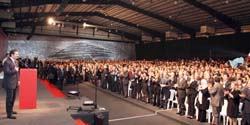
Addressing a rally marking the sixth anniversary of the assassination of his father, former Prime Minister Rafik Hariri, Saad Hariri lashed out at Hezbollah for using its weapons to influence internal political disputes and rejected the group’s accusation that the Special Tribunal for Lebanon was an American or Israeli tool.
“Dear friends, today we are in the opposition, which is based on the three following principles – First: We are committed to the Constitution. Second: We are committed to the Special Tribunal for Lebanon. Third: We are committed to protect the public and private life in Lebanon from the predominance of weapons,” Hariri told the rally held at the Beirut International Exhibition and Leisure complex in Beirut.
The rally drew about 8,000 supporters, including ministers in Hariri’s caretaker Cabinet, lawmakers from Hariri’s Future bloc and the March 14 coalition, as well as Kataeb (Phalange) Party leader Amin Gemayel and Lebanese Forces chief Samir Geagea.
Hariri’s declaration was widely expected because he has said he will not join a government headed by a March 8-backed candidate. Also, March 14 groups’ talks with Mikati, who is backed by the Hezbollah-led March 8 alliance, on their participation in the new government had collapsed.
In his speech, Hariri thanked the lawmakers who collaborated to oust him from office last month, saying this allowed him to return to his supporters.
“I announce today what I implicitly say everyday: Thank God, thank God … We are returning to the path of basic sound peaceful national constants drawn by the Lebanese people from all sects, regions and groups on March 14, 2005, that they never retracted from, even when they felt that our good intentions are pushing us to stances and settlements that are for Lebanon’s sake but outside this path,” he said.
“We are not attached to power and we only adhere to our democratic system and Constitution. So we congratulate them on a majority that was hijacked by the intimidation of weapons and we congratulate them on a power that was stolen from the will of the voters,” Hariri said.
Hariri said the hundreds of thousands of Christians and Muslims who protested his father’s killing on March 14, 2005, wanted to know the truth. “All we wanted since Feb. 14, 2005, and March 14, 2005, is the truth, not power. Justice, not power. Freedom, not power. All we want is the law, the Constitution and coexistence, not power. We want sovereignty, not power. And independence, not power,” he said.
Hariri reiterated support for the STL, rejecting charges that the tribunal was set up to serve U.S. and Israeli interests. “This tribunal is not American nor French nor Israeli, and doesn’t target any group or sect. This tribunal represents, in our point of view, the highest degree of human justice. This tribunal will surely punish, with the help of God, only, and I reiterate only the terrorist murderers who targeted many of our personalities, starting with [former] Prime Minister Rafik Hariri,” Hariri said.
He added that in accordance with its statute, the tribunal will accuse members, not a party or a sect. “It has to be based on evidence and proof,” he said.
“And then, if any one wants to put himself on the accused list, it will be his choice, and this way he chooses by himself. As for us, we will support the tribunal, its decision and its verdict. We will not say one day that the accusation was directed against a particular sect, party or group,” he added.
Hariri said his remarks were not aimed at seeking a confrontation with the Shiite sect. “The Shiite community is a fundamental part of the Lebanese structure, and all the Lebanese are its partners in building the state, and confronting the Israeli enemy.”
The STL has been at the root of tension between March 8 and March 14 groups for months, threatening to plunge the country into sectarian violence, especially if the tribunal’s indictment implicates some Hezbollah members in Hariri’s assassination as it is widely expected.
Hariri said following his victory in the 2005 and 2009 elections, he extended his hand to Hezbollah and its allies because this country cannot be governed by a single party or a single sect. “But we were met every time with deceit, and our genuine intention was taken as a point of weakness and a sign of fear,” he said.
Hariri said Hezbollah’s weapons have become a divisive issue among the Lebanese after these weapons were used against fellow Lebanese in May 2008. Pro- and anti-government groups fought each other in May 2008 after Hezbollah gunmen briefly took over West Beirut to protest a government decision to dismantle the group’s private telecommunications network.
“Yes, we don’t accept the weapons and to be subjugated to them when they are directed against the Lebanese and when they become a means of blackmail of their stability and security, so that they choose the wrong over the right, or when they become a means of pressure on members of Parliament to do the opposite of what the voters entrusted them to do and to breach the vows they made when they ran for elections,” he said. “Weapons directed against the Lebanese people are weapons of strife, and strife in Lebanon serves only Israel, which is our only enemy.”
Hariri disclosed for the first time details of the Saudi-Syrian settlement to resolve the Lebanese crisis over the STL and what led the deal to unravel. He implicitly blamed Hezbollah and its March 8 allies for the failure of the Saudi-Syrian bid.
He said the Saudi-Syrian initiative was based on one essential idea: that all Lebanese parties participate in a Lebanese national reconciliation conference to be held in Riyadh under the auspices of Saudi King Abdullah and in the presence of the Lebanese and Syrian presidents, a number of Arab leaders and the Arab League.
“A reconciliation of everyone without exception, and forgiving all the past, in a way that the repercussions of the indictment would be a national and Arab responsibility,” he said,
“Yes, this is the agreement that we negotiated for. … We negotiated in all honesty for the sake of Lebanon’s interest, but we were met once again with a request to surrender, and not to reconcile, by those who don’t want a dialogue because they consider themselves bigger than Lebanon,” he added.
Hariri said there will be no return to the Saudi-Syrian efforts. He denied reports that he had signed an agreement to end Lebanon’s cooperation with the STL.
Taking a direct swipe at Mikati who is known for his middle-of-the road attitudes, Hariri said, “There is no centrism between crime and justice, between sovereignty and tutelage, and between Lebanon’s Arabism and putting it in a regional axis that has nothing to do with Arabism or Lebanon. But most importantly there is no centrism between truth and deception, between pledges and treason.”
Addressing the rally, Gemayel said the March 14 movement will achieve its objectives “because it is the movement of right and historic constants.” He accused the Hezbollah-led alliance of seeking to bring Lebanon down.
“In theory, we are in front of a government’s collapse. But in reality, we are seeing an attempt to bring Lebanon down. Will you allow Lebanon’s downfall?” Gemayel asked.
Geagea blamed Syria for the Lebanese crisis. “The March 14 coalition has made mistakes several times, especially when it believed that Syria had made a comprehensive review of its attitudes toward Lebanon,” he said. He promised “endless Cedars’ revolutions” to confront Syria’s and Hezbollah’s tutelage over Lebanon.
Former Minister Mohammad Abdel Hamid Beydoun, a former Amal official who has fallen out with Speaker Nabih Berri, spoke at the rally criticizing Hezbollah for keeping its weapons in defiance of the state.
“The resistance [Hezbollah] cannot continue as an independent army beyond accountability. Lebanon cannot remain with two armies and two kinds of weapons,” he said.
Now with the March 14 participation ruled out following Hariri’s declaration, Mikati is expected to intensify his efforts to form the government which is to be dominated by Hezbollah and its allies.
A senior March 8 source said that Mikati met Monday with and caretaker Energy Minister Jubran Bassil in the latest attempt to resolve the problem of the interior portfolio which both Sleiman and MP Michel Aoun are demanding.
A source close to Mikati said if the March 14 bloc decided to stay out, the premier-designate would form a government of politicians and technocrats.
Meanwhile, U.S. President Barack Obama urged the new Lebanese government to cooperate with the STL. “Ending the era of impunity for political assassinations is essential to realizing the justice and stability that the Lebanese people deserve, and any attempt to interfere with the Tribunal’s work or fuel tensions within Lebanon must not be tolerated,” Obama said in a statement Sunday. “The cause for which Prime Minister Hariri and so many Lebanese patriots gave their lives must remain our guide.”
Hariri supporters flock to BIEL to remember slain statesman
Attendees insist March 14 coalition strong as ever, urge Mikati to step down
By Wassim Mroueh
BEIRUT: Ahmad Naaman left his north Lebanon village in Akkar and headed to Beirut Monday to take part in a ceremony to mark the sixth anniversary of former Prime Minister Rafik Hariri’s assassination.
“I came to stand by the side of [caretaker Prime Minister] Saad [Hariri] for the sake of truth. God willing, truth will come,” he told The Daily Star.
Naaman was like many other March 14 coalition officials and supporters who attended the ceremony that took place in Beirut International Exhibition and Leisure Center (BIEL).
Speakers were regularly interrupted with cheers and applause as they attacked Syria, Hezbollah and its allies.
Around 8,000 March 14 partisans and officials filled two halls in the facility, contrary to previous years when an outdoor rally was held in Beirut’s Martyrs Square to commemorate Hariri’s slaying.
“On March 14, a huge rally will take place, and will deliver a message that Saad Hariri is not alone,” Naaman added, urging Prime Minister-designate Najib Mikati to step down and side with Hariri in support of the Special Tribunal for Lebanon.
The Hezbollah-led March 8 coalition had recently secured a parliamentary majority that nominated Mikati as prime minister-designate and sidelined Hariri.
But Naaman said that “despite threats and pressures, March 14 supporters are getting stronger.”
March 14 MPs were greeted with rounds of applause as they entered the hall, with the clapping growing more pronounced as Hariri arrived, accompanied by Kataeb (Phalange) Party leader Amin Gemayel.
Huge portraits of the late Hariri and other slain officials from the March 14 coalition were on display on the walls of the hall.
Lamia Jardali, hailing from the southern coastal city of Sidon, said she came to stress her principles in support of Hariri. “We came to remember the martyr Prime Minister Rafik Hariri, whom we raise our children admiring. He was a great man who built the country,” she said.
Jardali said marking Hariri’s assassination in a closed hall did not indicate that the March 14 coalition had grown weaker. “Our leaders decided that we gather here … if we were asked to convene in Downtown Beirut, we would have filled the area as usual,” she said.
She said the March 8 coalition had proven that those who held arms ruled.
“But we are strong in our education and thoughts, we support people who taught [others] and built [the country]. But they are destroying and killing. We support people who killed no one. But the other side’s hands are covered in blood,” she said, referring to Hezbollah.
But for Mohammad Qoleilat, who comes from Beirut, the Future Movement should acquire arms to protect the Sunnis, after the army failed to fulfill the task during the clashes of May 2008.
“We believe in the army, but the army did not protect [us] on May 7, the Future Movement should obtain arms to defend the Sunnis,” he said.
In May 2008, pro-Hezbollah gunmen overran western neighborhoods of Beirut after the Cabinet of former Prime Minister Fouad Siniora decided to dismantle the party’s telecommunications network.
Qoleilat said he was taking part in the gathering to ask for the truth regarding crimes that claimed the lives of “Sunni” leaders.
In addition to speeches by Hariri, Gemayel, Lebanese Forces leader Samir Geagea, ex-Minister Mohamamad Abdel-Hamid Beydoun and other March 14 officials, the ceremony which lasted for two-and-a-half hours saw the screening of short documentaries featuring the slain March 14 coalition officials.
A woman who was holding the Lebanese Forces flag said that she was disappointed by the performance of March 14 coalition.
“I have been participating in all gatherings called for by the March 14 coalition, but I am disappointed because the younger Hariri has committed many mistakes,” she said. “He made mistakes when he made many concessions, and when he said that there were false witnesses. He is a kind man, but he was betrayed by the other side,” she added.
The woman, who asked to remain anonymous, complained about the size and the location of the place where the ceremony was held.
“Cars coming from eastern [Christian] areas could not arrive to the place. Why did they decide to squeeze people in this place?” she asked.
Young men in back seats, wrapped with blue scarves and holding Future Movement flags, chanted slogans against Hezbollah, Syria, head of the Progressive Socialist Party MP Walid Jumblatt, Mikati and Free Patriotic Movement leader MP Michel Aoun.
“The people want to topple Najib,” they said, echoing slogans chanted by Egyptian protesters against ousted Egyptian President Hosni Mubarak.
|